
Scalable web app development is about making growth boring. When a marketing campaign works or a large customer signs, the app should handle the extra users and data without outages or emergency rewrites. This guide covers the principles we follow at Savoir Management and the mistakes that most often force expensive rebuilds.
Why does scalability matter more than ever in 2026?
Users expect fast, reliable apps on every device, and a single viral moment or large customer can multiply traffic overnight. Apps that cannot scale lose customers exactly when growth arrives.
What are the core principles of scalable web app development?
Keep application servers stateless, design data carefully, cache what is read often, move slow work to background jobs, automate testing and deployment, and monitor everything.

The Twelve-Factor App methodology and AWS Well-Architected Framework describe these practices in depth.
Stateless app tier: store sessions and files outside the server so you can add servers.
Data design: normalized schemas, indexes on common queries and read replicas when needed.
Caching: cache expensive queries and pages; use a CDN for static assets.
Background jobs: emails, reports and imports run in queues, not during requests.
Automation: continuous integration, automated tests and repeatable deployments.
Which mistakes do businesses make when building apps?
Building too many features before validating the core, ignoring data design, hand-rolling security and billing, skipping automated tests and having no monitoring. Each one becomes expensive as usage grows.
Premature microservices that slow a small team
No indexes or caching, so the database becomes the bottleneck
Security added late instead of designed in
Manual deployments that make every release risky
How should security be built into a scalable app?
Use proven authentication, role-based permissions, encryption in transit and at rest, input validation and dependency updates. Security problems grow with your user base, so design for them early.
Build against the OWASP Top 10. If you add AI features, review the OWASP Top 10 for LLM applications.
What role does scalability play in long-term growth?
Scalable foundations keep costs predictable, let teams ship features faster and protect revenue during spikes. They also make it easier to add integrations, new markets and enterprise customers.

How do you keep a growing app fast for users?
Measure real user performance, optimize the slowest screens and API calls first and keep front-end bundles lean. Users judge an app by how it feels.
Use Interaction to Next Paint and other Web Vitals to track responsiveness.
How does Savoir Management build scalable web apps?
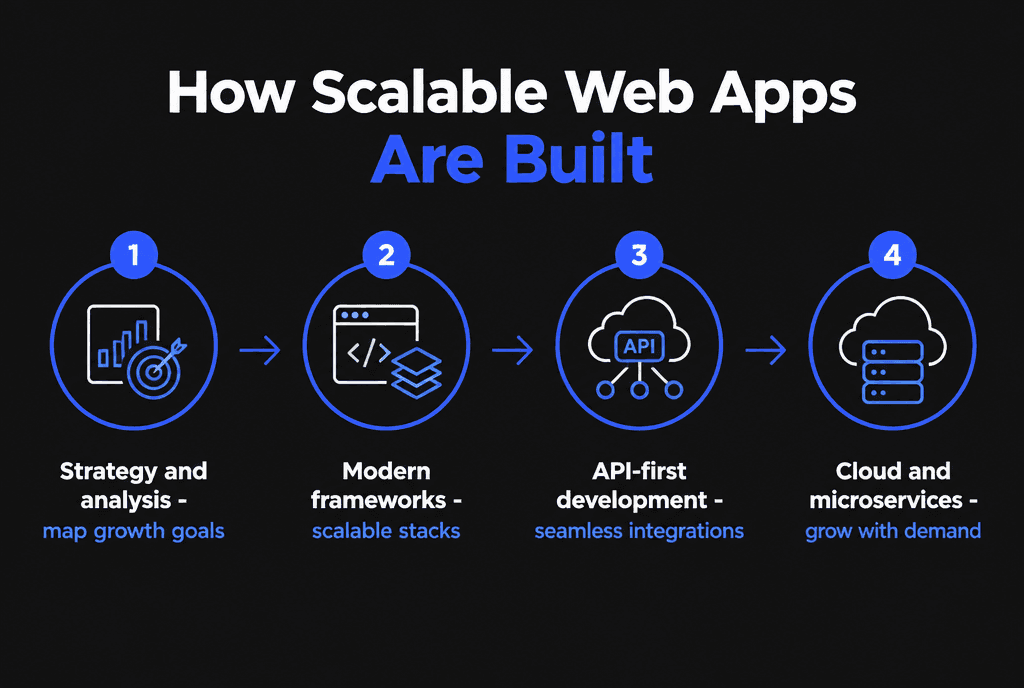
We validate the core workflow, choose a proven stack and managed cloud services, design data and security up front, automate testing and deployments and set up monitoring before launch.
Planning a SaaS product? Read our SaaS platform development guide and recurring revenue platforms. For budgeting, see how much custom web development costs. Our custom web development team builds web apps.


