
Choosing among web development packages for startups is harder than it looks. Some packages are so thin you outgrow them in three months; others sell you an enterprise build before you have ten customers. The right package helps you launch quickly, look credible to customers and investors, learn from real traffic and grow without starting over. This guide explains what to include, what to skip and how we structure startup packages at Savoir Management.
Why does a startup website matter so early?
Customers, investors, partners and candidates all check your website before they talk to you. A clear, fast, credible site shortens every conversation, while a weak one raises doubts you never hear about.
Early on, the website does three jobs at once: it explains what you do in seconds, it captures interest through sign-ups, demos or purchases, and it teaches you which messages and channels work. The U.S. Small Business Administration's guidance on marketing and sales stresses understanding your customers and how they buy. Your website is where that understanding gets tested at scale.
What key features should every startup package include?
Positioning support, responsive design, core pages, an editable CMS, conversion paths, SEO foundations, analytics and conversion tracking, and secure, scalable hosting.
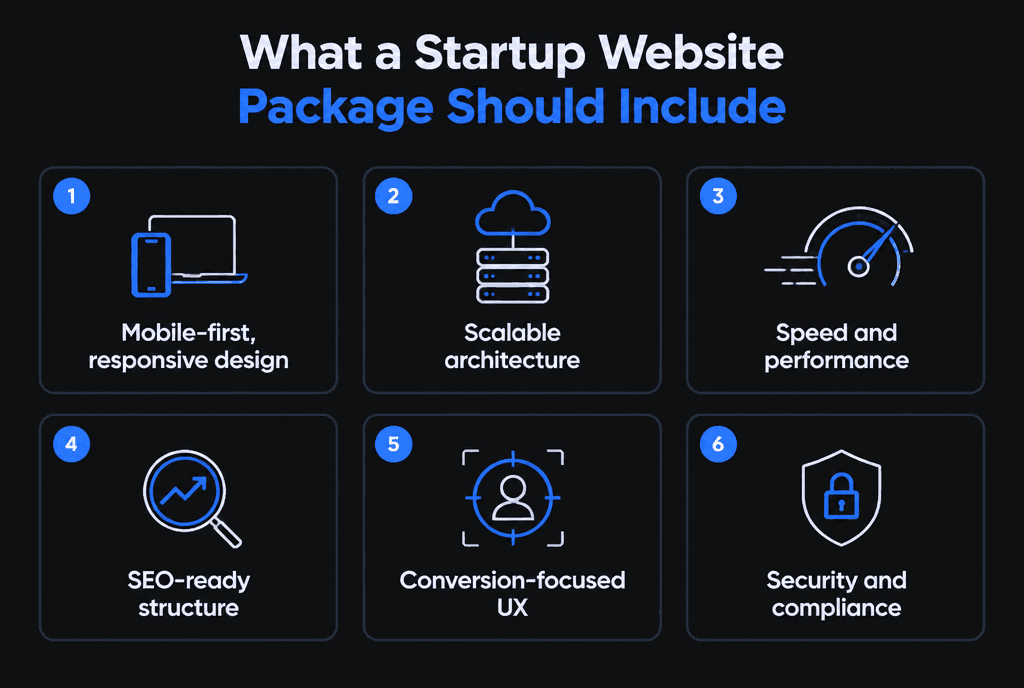
A solid startup package includes:
Messaging workshop: who you serve, the problem, your solution and why you are different
Core pages: home, product or services, pricing, about, resources or blog, contact or demo
Design system: reusable components so new pages are fast to create
CMS: your team can publish updates, case studies and posts without developers
Conversion paths: demo requests, waitlists, free trials, consultations or checkout
SEO foundations: titles, headings, structured data, sitemap and clean URLs, following Google's SEO Starter Guide
Analytics: events for every conversion using Google Analytics recommended events
Performance and accessibility: pages that meet Core Web Vitals and follow WCAG
What do typical startup package tiers look like?
Most providers offer a launch tier for a focused marketing site, a growth tier with more pages, content and integrations, and a scale tier for custom functionality, product sites or multiple audiences.
Launch: 5 to 8 pages, template-based or light custom design, CMS, forms, analytics and basic SEO. Suitable for pre-seed and early revenue stages.
Growth: 10 to 25 pages, custom design system, case study and resource templates, integrations with CRM and email, landing page templates for campaigns and more detailed SEO.
Scale: custom features such as calculators, portals, pricing configurators or product documentation, multiple audiences or regions, advanced tracking and ongoing development.
Prices vary widely by scope and provider. Our guide to website development costs in 2026 gives typical ranges.
What can a startup safely skip at launch?
Skip anything that does not help you win the next customers: elaborate animations, large content libraries, multiple languages, custom portals and advanced personalization. Add them once data shows they matter.
Every feature has a cost beyond the build: it must be designed, tested, maintained and kept fast. Launching lean lets you spend money on what the market is telling you, not on guesses. Keep a "phase two" list so good ideas are not lost, and revisit it after the first few months of real traffic and sales conversations.
What mistakes do startups make with web development?
Overbuilding before product-market fit, underinvesting in messaging, choosing platforms no one can maintain, giving up ownership of code or domain and launching without tracking.

Overbuilding: custom features that few visitors use and slow the site down
Vague messaging: clever slogans that do not say what the product does
Platform lock-in: obscure tools or custom builds only one freelancer understands
Lost ownership: domains or repositories registered to an agency or contractor
No tracking: months of traffic with no data on what converts
Ignoring speed: heavy hero videos and scripts that slow mobile pages
How should startups think about messaging?
Lead with the problem you solve and the outcome customers get, in language they use. Make it specific enough that the right people recognize themselves and the wrong people self-select out.
Test messaging with real prospects before the build is final. Five short conversations about your homepage headline often reveal more than weeks of internal debate. Nielsen Norman Group's guide to usability testing describes a simple approach you can run yourself.
Which platform should a startup choose?
Choose a mainstream platform your team can manage: a visual site builder or WordPress for marketing sites, Shopify for e-commerce, and a custom stack only for product functionality that platforms cannot provide.
A mainstream platform keeps hiring easy and avoids lock-in. If your product is a SaaS application, keep the marketing site separate from the app so the marketing team can move quickly without touching product code. See our guides to WordPress for business, Shopify vs WooCommerce and the SaaS platform development process.
How long does a startup website take to build?
A launch-tier site with ready content can go live in one to three weeks. Growth-tier sites usually take four to eight weeks, and scale-tier projects with custom features take longer. Content readiness and decision speed matter more than the build itself.
The fastest projects have one decision-maker, a clear brief, final copy or detailed notes, and brand assets ready before design starts. Slow projects are usually waiting on content or approvals. If a fundraising round, product launch or event sets your deadline, tell your partner early so the scope can be shaped to fit.
How do you make sure the site can scale?
Use a component-based design system, a clean URL structure, an editable CMS and documented code, and keep every account in the company's name. Scaling then means adding pages and features, not rebuilding.
Plan URLs for future sections, such as /solutions, /industries, /resources and /customers, even if some launch later. Store design files and brand assets in shared company accounts. When you add subscriptions or payments, use proven services; Stripe documents how subscriptions work for recurring billing.
What should startups measure after launch?
Track visitors by source, conversion rates for each call to action, sign-up or demo completion, and which pages influence conversions. Review monthly and adjust messaging and channels based on what the data shows.
Early numbers are small, so look for clear patterns rather than tiny percentage changes. If paid campaigns bring traffic but few sign-ups, test the landing page offer. If organic visitors convert well, invest in content. Our guide to high-converting landing pages covers testing in detail.
How should startups use content and SEO early?
Start with a handful of pages that answer the questions your best prospects search for, such as comparisons, use cases and "how to" guides tied to the problem you solve. Early content compounds, so begin before you need it.
Search traffic takes months to build, which is why startups that publish early have an advantage when they are ready to scale. Focus on depth over volume:
One page per core use case or audience
Honest comparison pages against the alternatives buyers consider
Guides that answer the questions sales calls keep surfacing
Customer stories as soon as you have results to share
Google's guidance on helpful, people-first content rewards first-hand expertise, which founders have in abundance. Link each article to the relevant product or service page so readers have a clear next step.
What should you ask before buying a package?
Ask exactly what is included, who owns the result, how the site can grow, what support looks like after launch and how the partner will measure success.
Which pages, components and integrations are included, and what costs extra?
Will we own the domain, design files, code and content?
Can our team edit pages and create new ones without a developer?
How do you handle speed, accessibility and SEO foundations?
What tracking will be set up before launch?
How do we add features later, and how are those priced?
What happens if we need changes after launch?
The answers tell you whether a package is built for a startup's pace or for a one-time handoff. Our guide to choosing the right web development company lists more questions and red flags.
How do you protect the company's ownership?
Register the domain to the company, keep administrator access to hosting, CMS, analytics and code repositories, and make sure contracts transfer ownership of design and code once paid.
This matters for due diligence: investors and acquirers expect the company to own its digital assets. Ownership also lets you change partners without losing your site.
Why are Savoir Management's packages built for growth?
Our startup packages combine messaging support, a reusable design system, conversion paths, SEO and analytics in the first release, with a clear path to add pages and features as you grow.

We scope each tier around your stage and goals, launch quickly and stay involved after launch to improve conversion rates. Talk to our web development team or custom web development team, and read how to get a website built in 7 days if speed is your priority.


