
Hiring a local web developer for a small business can be one of the best investments you make, or an expensive lesson. The difference usually comes down to the questions you ask before signing. This guide covers what we wish every small business owner knew before hiring a developer, from setting goals to protecting the investment, based on the projects we inherit and rebuild at Savoir Management.
Why does choosing the right developer matter so much?
Your website is often the first place customers judge your business. The right developer builds a site that brings in calls, bookings and sales; the wrong one leaves you with a site that looks fine but produces little, or that you cannot update, move or fix.
Problems from poor hires tend to surface months later: the site is slow, rankings never arrive, a plugin breaks, or the developer disappears with the login details. Avoiding those problems starts before you contact anyone.
How should you set clear goals before you begin?
Write down what the website must achieve, who it is for, which actions visitors should take and how you will measure success. Clear goals help you compare proposals and keep the project focused.

A one-page brief should cover:
Business goal: more calls, bookings, quote requests or online sales
Audience: who your best customers are and what they need to know
Must-have features: booking, payments, galleries, menus, forms or integrations
Pages: services, locations, about, reviews, contact and any others you need
Content: who will write copy and provide photos
Budget and timeline: a realistic range and any hard deadlines
With a brief, two developers quoting the same project are actually quoting the same thing.
Does hiring local actually matter?
Local developers are easier to meet, may understand your market and competitors and can sometimes help with photography or on-site content. But portfolio, process and results matter more than distance.
Hiring local makes the most sense when you value in-person meetings, need help gathering content on site, or want someone who already knows the local competition. If no local developer has the skills you need, a remote team with a strong process is the better choice.
Should you hire a freelancer or an agency?
Freelancers are often more affordable and personal, which suits simple sites. Agencies bring a team of designers, developers, writers and SEO specialists, which suits larger projects, tight deadlines and ongoing marketing.
A capable freelancer can build an excellent small business website, but one person has to cover strategy, design, development, content, SEO and support, and projects stall if they get sick or busy. An agency costs more but spreads that work across specialists and usually offers more dependable support. Whichever you choose, check who will actually work on your project and who you will contact when something breaks. If you are weighing the jump, read 10 signs it's time to hire a web development agency.
Which qualities make a developer deliver results?
Look for a portfolio of similar businesses with measurable outcomes, a clear process, real local SEO knowledge, attention to speed and accessibility, honest communication and support after launch.
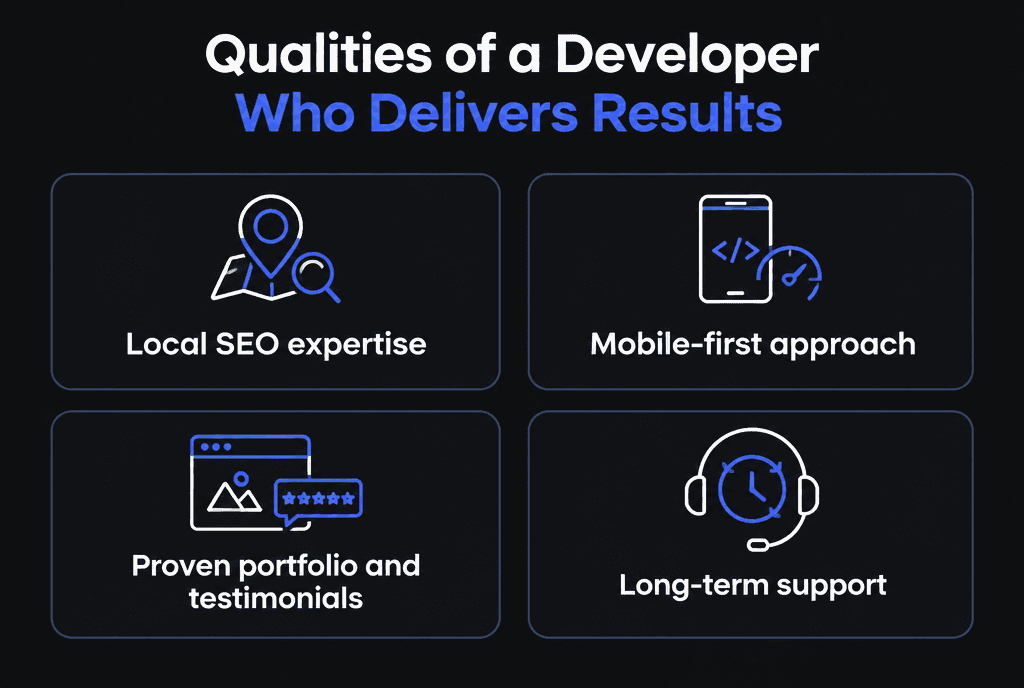
Relevant portfolio: sites for businesses like yours, ideally with results such as more leads or bookings
Process: discovery, sitemap, design, build, testing and launch steps explained upfront
Local SEO skill: service and location pages, Google Business Profile alignment and structured data
Performance and accessibility: an understanding of Core Web Vitals and WCAG
Communication: clear updates, plain-language explanations and responsive replies
Support: maintenance, security updates, backups and help after launch
What local SEO skills should a developer have?
A developer serving local businesses should know how to build service and location pages, add LocalBusiness structured data, keep business details consistent and support your Google Business Profile.
Google ranks local results on relevance, distance and prominence, according to its local ranking tips. A developer cannot change your distance from a searcher, but the site can strengthen relevance and prominence. Ask how they would use LocalBusiness structured data and how they plan pages for each service and area. Our local SEO web development guide covers what good looks like.
What questions should you ask before hiring?
Ask about similar projects and results, what is included, ownership, post-launch support, how SEO, speed and accessibility are handled and how success will be measured.
Can you show sites you built for businesses like mine, and what results did they get?
What exactly is included in the quote, and what is not?
Who will own the domain, design files, code and content?
How do you handle mobile speed, SEO basics and accessibility?
Which platform will you use, and can I update content myself?
What happens after launch: maintenance, updates, backups and support?
How will we measure success, and will you set up analytics and conversion tracking?
Who will actually work on my project?
What red flags should you watch for?
Vague proposals, guaranteed first-page rankings, no portfolio or references, pressure to sign immediately, refusing to put ownership in writing and no plan for security or support.
Promises like "guaranteed #1 on Google," which no one can honestly make
Very low prices with no clear scope, which often mean templates with little customization
Developers who register your domain in their own name
No contract, or a contract without revisions, timelines or ownership terms
No mention of backups, updates or security
Our guide to choosing the right web development company covers more warning signs.
How should you compare proposals?
Compare proposals on scope, process and outcomes, not price alone. Line them up against your brief and check what each includes for content, SEO, speed, accessibility, training and support.
Two quotes that differ by thousands of dollars often describe different projects. One may include copywriting, a page for every service and location, speed optimization and three months of support; the other may be a template with your logo added. Use a simple table to compare:
Number of pages and unique page designs
Who writes content and sources photos
SEO setup: titles, structured data, sitemap and redirects
Performance targets, such as meeting Core Web Vitals on mobile
Accessibility approach, ideally referencing WCAG
Analytics and conversion tracking
Training, documentation and post-launch support
Payment schedule and timeline
Ask each developer to explain anything unclear in plain language. How they answer tells you a lot about what working with them will be like.
What should the contract include?
A written scope with pages and features, a timeline with milestones, payment terms, revision limits, responsibilities for content, ownership transfer, support terms and what happens if the project ends early.
Ownership deserves special attention. The U.S. Copyright Office explains what copyright protects, and in commissioned work copyright generally stays with the creator unless an agreement says otherwise. Make sure your contract transfers ownership of the design, code and content to your business once paid, or at least grants you a clear, permanent license. Have the agreement reviewed by your own advisor if the project is large.
How do you protect your investment?
Register the domain in your own name, keep administrator access to hosting and every account, store copies of design files and content, and set up backups and a maintenance plan.

ICANN's information for domain name registrants explains your rights and responsibilities as a domain owner, including keeping your contact details current. Practical steps:
Domain registered to your business, with your email as the account owner
Your own logins to hosting, CMS, analytics and Google Business Profile
Regular off-site backups and a documented restore process
Security updates and monitoring, ideally under a maintenance plan
A shared folder with brand assets, copy and photos
How much should a small business website cost?
Many professional small business websites cost a few thousand to around $15,000, depending on the number of pages, custom features, content and integrations. Ongoing maintenance and hosting are separate.
Labor drives most of the price. The U.S. Bureau of Labor Statistics lists 2025 median pay for web developers and digital designers at $99,520 a year, or $47.85 an hour, before overhead. See our 2026 website cost estimates and pricing breakdown for custom web development.
What should happen after launch?
Your developer should confirm analytics and forms work, submit your sitemap, monitor for errors, keep software updated and review performance with you after the first few weeks.
A good launch is followed by a short review: which pages get traffic, which produce calls and bookings, and what to improve next. Our website launch checklist lists what to check on launch day.
How does Savoir Management work with small businesses?
We start with your goals, share a clear scope and timeline, build fast, accessible and search-ready sites, put ownership in writing and support you after launch.
Our web development team works with small businesses on WordPress, Shopify and custom builds. Read also web development services every small business needs and our web development strategy for service-based businesses.


