Conversion-focused web development treats a website as a sales tool, not a brochure. Traffic only matters if visitors take the next step. This guide covers the development and design decisions that most affect conversions, based on the lead generation and e-commerce sites we build at Savoir Management.
Why do conversions matter more than traffic?
Doubling traffic to a site that converts 1% gives the same result as doubling the conversion rate on existing traffic, but improving conversions also lowers the cost of every future visitor from ads and SEO. Conversion rate is the multiplier on all other marketing.
Traffic graphs feel good, but you cannot pay employees with page views.

What is the first thing visitors need to see?
Visitors need to understand what you offer, who it is for and what to do next within seconds. Put a specific headline, a one-line value proposition and a single primary call to action above the fold.
Nielsen Norman Group found that users often leave web pages within 10 to 20 seconds, but a clear value proposition can hold attention far longer. Replace vague slogans with outcomes: "Get more booked appointments from your website" beats "Innovative digital solutions."
Which website mistakes kill conversions?
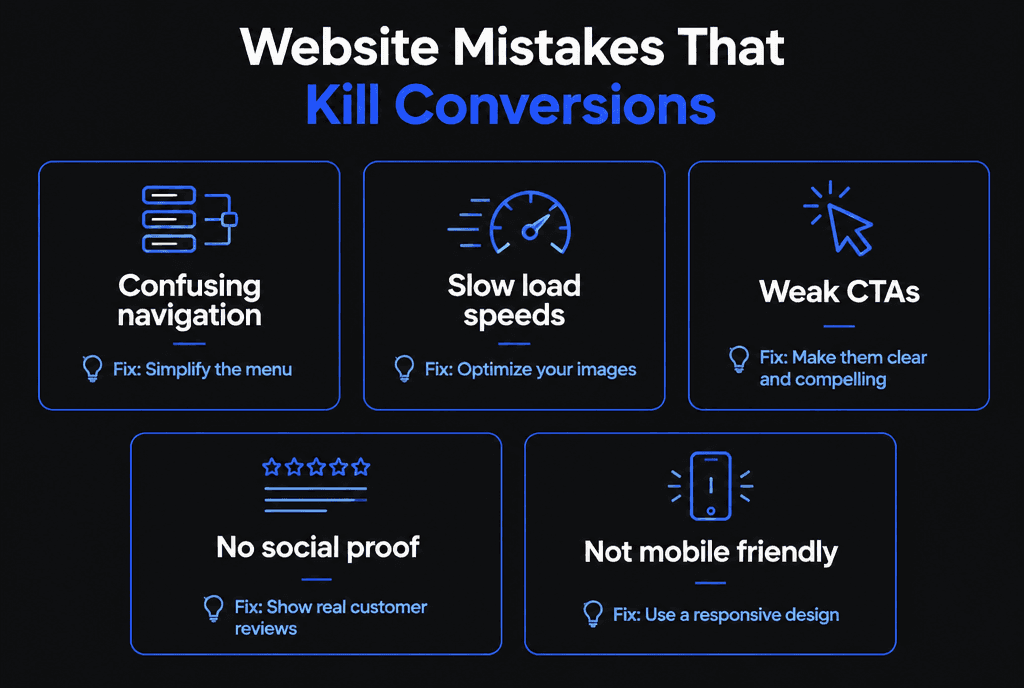
Confusing navigation, slow loading, weak calls to action, missing social proof and poor mobile experience are the five mistakes we fix most often.
How should calls to action be designed?
Use one primary call to action per page, phrase it as the benefit ("Get my free quote"), make it visually dominant and repeat it after key sections. Secondary actions should look secondary.
Place the primary CTA above the fold and after proof sections.
Use action-specific labels instead of "Submit."
Reduce competing links near the CTA.
How do forms affect conversion rates?
Every extra field adds effort, so ask only for what you need to follow up. Short forms with clear labels, inline validation and a visible privacy note convert better.
Follow accessibility basics from WCAG: visible labels, helpful error messages and keyboard support. On checkout, Baymard Institute puts the average documented cart abandonment rate at 70.22%, with complicated checkouts among the reasons shoppers leave.
How do UX and psychology influence conversions?
People act when they understand the offer, trust the business and see low risk. Clear hierarchy, consistent design, social proof, guarantees and transparent pricing reduce uncertainty.
Nielsen Norman Group's 10 usability heuristics, such as visibility of system status and error prevention, are a practical checklist for reviewing pages.

Why does speed matter for conversions?
Slow pages lose visitors before they see your offer. Meeting Core Web Vitals targets keeps pages fast, responsive and stable while people decide.
Google's Web Vitals targets are LCP within 2.5 seconds, INP of 200 milliseconds or less and CLS of 0.1 or less. Read our guide to improving site speed.
How should a conversion-focused site work on mobile?
Design for thumbs first: tap-friendly buttons, click-to-call, short forms, sticky CTAs and fast pages. Most visits now happen on phones.
Pew Research Center reports 91% of U.S. adults own a smartphone. See our guide to mobile-responsive web development.
How do you measure and improve conversions?
Define conversion events, track them in analytics, review funnels to find drop-offs and test changes one at a time. Improvement is a monthly routine, not a launch task.
Set up Google Analytics with recommended events like generate_lead and purchase. Review:
Conversion rate by page and traffic source
Form start versus form completion
Mobile versus desktop conversion
Pages with high exits before the CTA
What is the ROI of conversion-focused development?
Because conversion improvements apply to all traffic, even small lifts compound. Moving from 2% to 3% on 2,000 monthly visitors adds 20 leads a month without spending more on ads.
Related guides: landing pages that convert, UX-driven development and turning your website into a lead generation machine. Our web development team builds every site around conversion goals.