
Learning how to launch a Google Ads campaign profitably is mostly about doing things in the right order. Most wasted budget comes from launching before tracking works, bidding on vague keywords and sending clicks to a homepage. This seven-step checklist is the one we follow for every new account at Savoir Management.
Step 1: How do you set profitable campaign goals?
Define one primary conversion and a target cost per acquisition based on your margins and close rate. Without a target, you cannot tell whether a campaign is profitable or just busy.
Work it out on paper:
Average sale value: $1,500
Gross margin: 50%, so $750 profit per sale
Lead-to-sale close rate: 25%
Maximum cost per lead to break even: $750 x 25% = $187.50
Set your target below break-even, for example $120 per lead, and judge everything against it.

Step 2: How do you set up conversion tracking?
Install conversion tracking before spending a dollar, and count only valuable actions such as purchases, qualified form fills and calls longer than a minute. Smart bidding learns from whatever you mark as a conversion.
Google lists the options in its guide to conversion tracking. Use Google Analytics and Google Tag Manager if you want one place to manage tags.
Step 3: How do you choose keywords that make money?
Pick keywords that signal intent to buy, group them into tight themes and add negatives from day one. Phrase and exact match keep early spend focused while you learn.
Google's tips for building a keyword list recommend thinking like a customer and grouping similar terms. In practice:
Prioritize "service + city," "buy," "price," "near me" and "best" modifiers.
Use phrase and exact match for the first month.
Add a starter list of negative keywords: free, jobs, salary, DIY, template, course.
Step 4: How do you build ads that command attention?
Write responsive search ads that include the keyword, a specific benefit, proof and a call to action, and add sitelinks, callouts and call assets. Relevant ads earn higher click-through rates and better Quality Scores.
Responsive search ads test combinations automatically, so give them distinct headlines: one with the keyword, one with a benefit, one with proof and one with an offer.

Step 5: How should you budget and bid at launch?
Start with a daily budget that can buy enough clicks to collect 15 to 30 conversions in the first month, keep bidding simple, and do not raise the budget until cost per conversion is near target.
Week 1 to 2: Maximize Clicks with a bid cap, or manual CPC, to gather data.
Once conversions are recording: switch to Maximize Conversions.
With steady volume: set Target CPA.
Google's guide to choosing a bid strategy explains each option.
Step 6: What landing page should the campaign use?
Send each ad group to a page that repeats the ad's promise, loads fast on mobile and offers one clear action. A dedicated landing page usually converts far better than a homepage.
See our landing page development guide for the full structure, and our site speed guide if pages load slowly.
Step 7: How do you scale a campaign without wasting money?
Scale only what works: raise budgets on campaigns that hit target cost, expand to keywords similar to your best converters and add remarketing. Review search terms weekly as spend grows.
Raise budgets about 20 to 30% at a time.
Add remarketing to site visitors through data segments.
Test Performance Max only once Search is profitable and tracking is reliable.

What advanced tactics improve ROI?
After the basics work, improve ROI with ad scheduling, device and location bid adjustments, offline conversion imports and audience layering on Search. Each one shifts spend toward the most profitable clicks.
Ad scheduling for the hours you can answer calls
Bid adjustments for top-performing locations and devices
Importing closed deals from your CRM so bidding learns from revenue
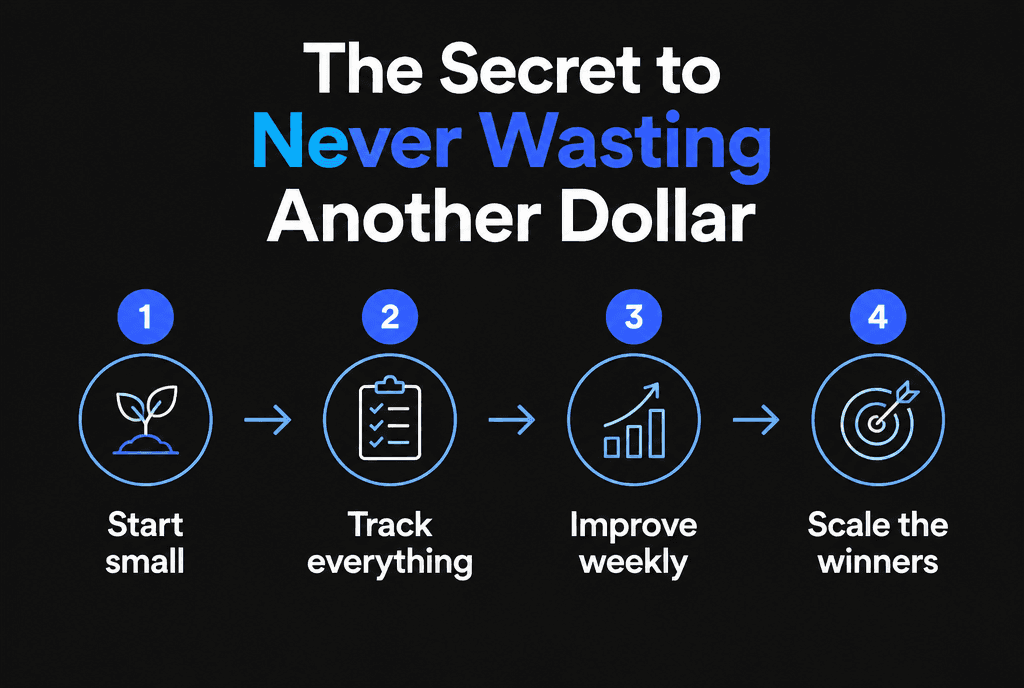
What is the secret to never wasting another dollar?
Start small, track everything, improve weekly and scale only the winners. Profit in Google Ads comes from a repeatable routine, not a perfect launch.
Next, read the Google Ads strategy we use for conversions and how to lower Google Ads CPC. Prefer a hands-off launch? Our Google Ads team builds and manages campaigns for small businesses.


